Why Street Trees Hold More Than a Canopy
Street tree layers create distinct places for leaves, insects and birds. Learn what to notice in branches, bark and planting pits without treating every tree alike.
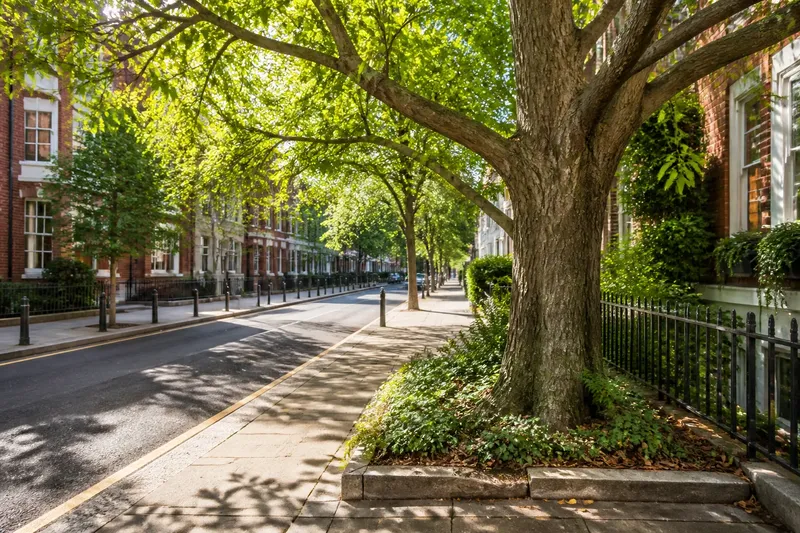
The common mistake with street trees is to look only at the canopy. That misses the trunk, branch junctions and ground-level planting space, where much of a tree’s small-scale life is easier to notice. Street tree layers matter because each shape offers different conditions; they do not turn every tree into a miniature woodland, and they do not make every tree alike.
1. Start with the crown’s outline
Stand where you can see the whole tree, then look at its outline rather than trying to name it. A narrow crown, a spreading crown and a crown with several distinct clumps present different arrangements of shade and shelter. The outline may also reflect nearby buildings, overhead wires, pruning or the tree’s natural growth habit.
Notice where the densest foliage sits. Some crowns hold leaves mostly near their outer edges, while others have leafy clusters distributed through the branches. A gap in the crown is not automatically a defect: it may come from a branch’s direction, limited light or a past pruning cut. The useful question is what the gap reveals about the shape, not whether the tree looks perfectly full.
Look again from the opposite pavement if it is safe to do so. A building can hide one side of a crown, and a view from below can make an open crown seem denser than it is. This is observation, not a reason to step into traffic or trespass for a better angle.
2. Read the branch layers
Street trees often have a clear sequence of forms: a main trunk, larger limbs, smaller branches and then shoots carrying leaves. Each layer changes the available space. Thick limbs provide sturdy perches; finer forks offer narrow footholds and places where leaves collect. Leaf clusters create shade and visual cover, but their value varies with the tree, season and surrounding conditions.
Try following one branch outward with your eyes. Where does it divide? Does it rise, hang, or run sideways? Are the leaves concentrated at its tip, scattered along it, or gathered in several bunches? These details help explain why two trees of similar height may have very different silhouettes and different opportunities for small animals.
Do not assume that a branch with no visible birds is unused. Wildlife may be elsewhere, or simply hard to spot against foliage and brickwork. A quiet observation can still tell you how the branches are arranged. The tree is not obliged to provide a performance on demand.
3. Look at leaf placement
Leaves are not just a green covering. Their size, spacing and position affect how light reaches the branches and ground. Broad leaves can overlap into a dense screen; smaller or more widely spaced leaves may leave clearer views through the crown. Some trees have leaves in distinct bunches at branch tips, while others carry them more evenly along their shoots.
Notice the underside of a low, safely reachable branch without pulling it down. Check whether leaves are fresh, folded, spotted, chewed or beginning to change colour. A small mark may have several possible causes, so avoid assigning it to a particular insect from appearance alone. The broader pattern is often more informative: a few marked leaves tell a different story from damage spread across much of a branch.
Leaves also change the tree’s available spaces through the year. A leafy crown can conceal branch junctions; after leaf fall, those joints and the tree’s branching pattern become easier to see. Neither view is the complete one. Returning in another season gives you a comparison rather than a verdict.
4. Examine bark and joints
The trunk is a habitat surface as well as structural support. Bark texture ranges from comparatively smooth to deeply ridged, and those differences create varied creases and sheltered spots. Look from the pavement without scraping, peeling or inserting anything into cracks. Bark is not a display case, and disturbance can harm whatever is using it.
Branch junctions are worth a closer visual look. A fork may hold a little fallen leaf litter or a damp patch after rain; a sturdy crotch can offer a bird a resting place. These are possibilities, not a checklist of occupants. A dry, exposed junction and a shaded, leaf-filled one are not interchangeable simply because both sit on the same trunk.
Also notice whether the trunk is shaded by the crown, a neighbouring building or nearby planting. Shade and exposure help describe the conditions around a tree, but they do not by themselves identify what lives there. Keep the observation to what you can see.
5. Include the tree pit
The small square or strip of soil around a street tree is part of its setting, even when paving makes it easy to overlook. Some pits are bare; others contain fallen leaves, low plants or mulch. Those materials change what is visible at ground level and may offer cover to small invertebrates, though a neat-looking pit is not proof of poor habitat and a leafy one is not proof of rich habitat.
Look for the boundary between soil, paving and trunk. Is the ground open or covered? Do leaves collect against the kerb, or does the surface appear swept clear? Is there a planted edge that connects the pit visually with a nearby verge or garden? These observations show how the tree sits within the street rather than treating it as a detached object.
Do not move mulch, lift paving or rearrange leaves to investigate. A useful look can be made from the public path, and a tree pit may be managed under local rules. The label, site instructions or local rules should guide any action beyond looking.
6. Compare without ranking
Comparison makes differences easier to notice, provided the aim is description rather than a contest. Choose two nearby trees and compare crown shape, branch spacing, leaf arrangement, bark and ground cover. They may be different kinds of tree, or the same kind shaped by different light, pruning and street conditions. A single visible feature rarely explains the whole difference.
Say you pass two trees on the same block: one has a dense crown above a bare paved pit, while the other has an open crown and fallen leaves around its base. You could note those starting conditions, then return after leaf fall to see which branches become visible and whether the ground cover has changed. The expected result is a clearer record of how each tree’s spaces differ, not a claim that one supports more wildlife.
A pocket notebook can keep observations plain: “forks low on north side” is more useful than “good tree”. A phone photo from the same public viewpoint can help you compare seasonal changes, but avoid photographing people closely or stepping into a road for the frame. The point is to notice the tree, not to produce a heroic documentary about a municipal plane.
What should you notice?
Where do birds perch?
Look for a bird’s position relative to the trunk, larger limbs and fine outer branches. A perched bird may be visible against an open crown and hard to see among dense leaves, so absence from view says little about whether the tree is used.
Can insects be seen on leaves?
From a safe, public position, scan leaf surfaces for movement, small clusters or feeding marks. Avoid touching or collecting insects; a brief sighting and a note about the leaf’s position are enough to make the observation useful.
Why do trees of the same kind look different?
Growth can respond to available light, nearby buildings, pruning and the space allowed around the crown. Those influences alter visible shape, so identification by silhouette alone can be uncertain.
Is a bare tree less useful?
A bare crown reveals branch structure that foliage can hide, while a leafy crown offers different cover and shade. The useful comparison is seasonal: note what becomes visible or concealed rather than treating one appearance as the better one.
Leave the small spaces alone
It is not worth trying to inspect every bark crevice, identify every leaf mark or search beneath the tree for proof of wildlife. Those efforts can disturb the very places you are trying to understand, and they often produce more certainty than the view supports. A steady look at several layers is enough.
Street tree layers are easiest to appreciate when you record specific features: an open fork, a dense leaf cluster, ridged bark or a planted pit. On your next walk, choose one tree and describe those parts separately. The result is a more accurate sense of the small spaces it holds, without mistaking one street tree for a template for all the rest.